Fan shaft bearings for vertical service.
Every air cooler fan shaft is vertical. That one fact decides which bearing belongs at the bottom, how to read its rating, and why the top one should float.
On this page: Tapered versus spherical · Load ratings · Korean and Chinese coolers · Top floating bearing
Why do spherical roller bearings fail on vertical fan shafts?
Spherical roller bearings handle thrust poorly compared with tapered roller bearings, and on an ACHE fan shaft the bottom bearing's main job is thrust. Bearing manufacturer application engineers at Dodge and SKF agree: avoid spherical rollers in vertical positions.
On every air cooler fan shaft the bottom bearing carries the thrust. The top bearing carries almost no load and acts as a guide.
- Contact. A tapered roller bearing has pure rolling contact across the whole contact patch. A spherical roller bearing has pure rolling at only two points and sliding everywhere else.
- Speed. In vertical service, if thrust load exceeds radial load, a spherical roller bearing's speed has to be derated to 70% of its limiting speed.
- Setup. Tapered roller units cost less and are far easier to set up correctly.
What is the best bottom bearing for an ACHE fan shaft?
A tapered roller bearing unit on the bottom and a ball bearing unit on top. The Dodge Type E tapered roller has a long track record as the bottom bearing on air cooler fans.
How do you compare tapered roller and ball bearing load ratings?
Multiply the tapered roller bearing's C90 rating by 3.857 to get a C rating you can compare directly with a ball bearing: C90 × 3.857 = C.
Ball bearings publish dynamic capacity, C, on the ABMA basis of 1 million revolutions. Tapered roller bearings are usually published on the Timken C90 basis of 90 million revolutions. Put side by side without converting, the tapered roller bearing looks weaker than the ball bearings. Converted, it's the strongest in the list by a wide margin.
11,800 (C90) × 3.857 = 45,513 lbs (C)
| Bearing | Type | Published rating | On a C basis |
|---|---|---|---|
| Dodge SCM | Ball | 13,995 | 13,995 |
| Link-Belt F339 | Ball | 14,100 | 14,100 |
| NTN UELF312 | Ball | 18,400 | 18,400 |
| Fafnir RCJO | Ball | 20,400 | 20,400 |
| Dodge Type E | Tapered roller | 11,800 (C90) | 45,513 |
| Bearing | Type | Published rating | On a C basis |
|---|---|---|---|
| Dodge SCM | Ball | 17,407 | 17,407 |
| Link-Belt F347 | Ball | 19,800 | 19,800 |
| NTN UELF312 | Ball | 25,500 | 25,500 |
| Fafnir RCJO | Ball | 28,500 | 28,500 |
| Dodge Type E | Tapered roller | 12,500 (C90) | 48,212 |
These are catalog values from 2015, shown to illustrate the conversion. Check current catalogs before selecting a bearing.
Why do bottom bearings fail on Korean and Chinese built air coolers?
Many Korean and Chinese built air coolers use a spherical roller bottom bearing locked to the vertical fan shaft with a taper adapter sleeve, and the shaft can slide through the adapter. The bearing itself is rarely the problem. The mounting is.
The usual arrangement is a 22316 spherical roller bearing in a housing stamped SCF316, on a 196 × 196 mm bolt pattern with a 70 mm bore. That housing is not a standard North American size, which makes an exact replacement hard to source.
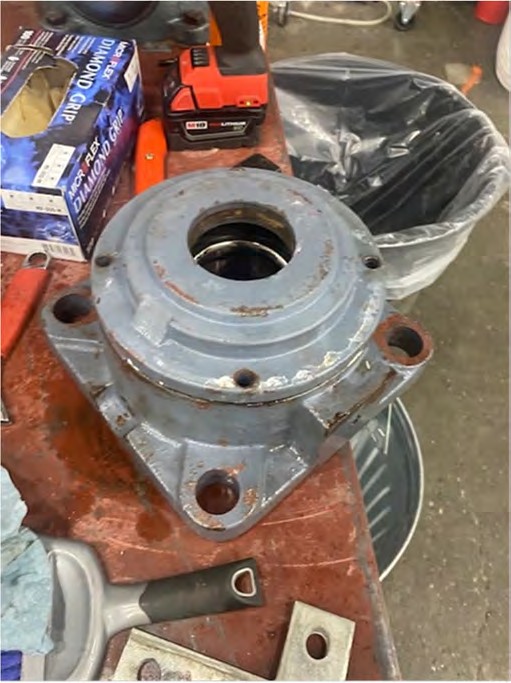
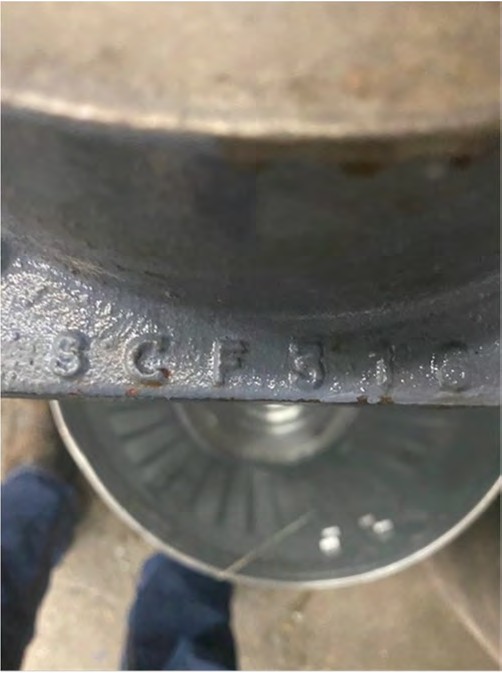
Why does a bearing with a 220 year life fail?
The 22316's calculated L10 life in this service is over 220 years. It fails anyway because a taper adapter sleeve is the wrong way to lock a bearing on a vertical shaft.
- The thrust load acts along the shaft, and the shaft can slide through the adapter sleeve.
- Two adapter mount bearings on one shaft, installed without allowing for the axial drive up, create preload problems. One of the two must be an expansion type.
If a taper adapter must stay on a vertical shaft
- Face the locknut down.
- Relieve all weight from the bearing during drive up.
- Ideally fit a thrust collar (clamping fixture) under the bearing so the axial load bypasses the sleeve. With the collar fitted, the nut goes on top.
What is the fix?
Timken now makes a drop-in tapered roller flange block for the SCF316 bolt pattern, locked with four set screws. It puts the proven North American bottom bearing arrangement, a tapered roller carrying the thrust, into the existing footprint.
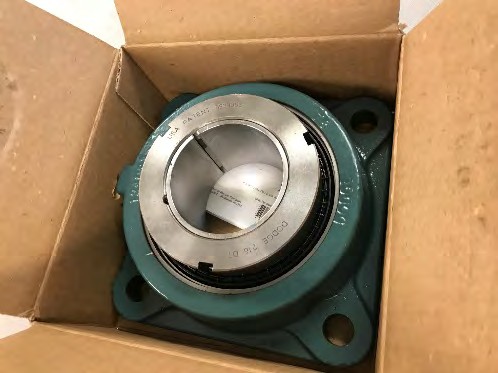
Replacing bottom bearings on Korean or Chinese built coolers? Tell us the unit and we'll talk it through.
When does an ACHE fan need a floating top bearing?
Fan shafts 2 15/16" and larger with more than 24" between bearings need a floating top ball bearing. Induced draft fans should always have one, because they run hotter.
Steel shafting grows about 0.0000063 inches per inch per degree Fahrenheit. With both bearings fixed, the growth has nowhere to go and loads both bearings.
48 in × 100°F × 0.0000063 = 0.030 in
That's two fixed bearings about 4 ft apart with a 100°F (56°C) temperature swing. A typical 215 series ball bearing (2 15/16") has only 0.011" to 0.016" of endplay, so 0.030" of growth is roughly double what the bearing can absorb. Smaller bearings have even less endplay.
| Span between bearings | 20°F (11°C) | 40°F (22°C) | 60°F (33°C) | 80°F (44°C) | 100°F (56°C) |
|---|---|---|---|---|---|
| 2 ft (24 in) | 0.003 | 0.006 | 0.009 | 0.012 | 0.015 |
| 3 ft (36 in) | 0.005 | 0.009 | 0.014 | 0.018 | 0.023 |
| 4 ft (48 in) | 0.006 | 0.012 | 0.018 | 0.024 | 0.030 |
| 5 ft (60 in) | 0.008 | 0.015 | 0.023 | 0.030 | 0.038 |
| 6 ft (72 in) | 0.009 | 0.018 | 0.027 | 0.036 | 0.045 |
Growth = span (in) × temperature swing (°F) × 0.0000063. Values in bold exceed 0.011", the low end of endplay in a typical 215 series ball bearing.
Is there a downside to floating the top bearing?
No. The top bearing on an ACHE fan shaft is only a guide, so letting it float costs nothing.
Which kind of floating bearing?
Specify an industry standard float bearing, where the bearing's outer ring is cylindrical and slides axially in the housing bore.
Avoid the style where a hardened set screw floats in a long keyway. That style has a history of failing fan shafts.
Related reading
- ACHE bearing and motor lubrication: factory greases, re-lube intervals, and solid lube.
- Forced draft versus induced draft, and why induced draft bearings run hotter.
- Fan parts by brand, including bearings, sheaves and drives.
- Common questions, including where to look when a fan vibrates.

Nick Agius, Founding Partner
48 years on air coolers, starting in 1978. Nick designed and patented the DG-II Anti Rotation Device® and created the E-Bell™. More about Nick.
Technical review by Russell De Jesus, P.Eng.
Want a second opinion on your fan shaft bearings? Tell us what you're running and we'll call you back with a straight answer.